Featured
 This Months Feature —
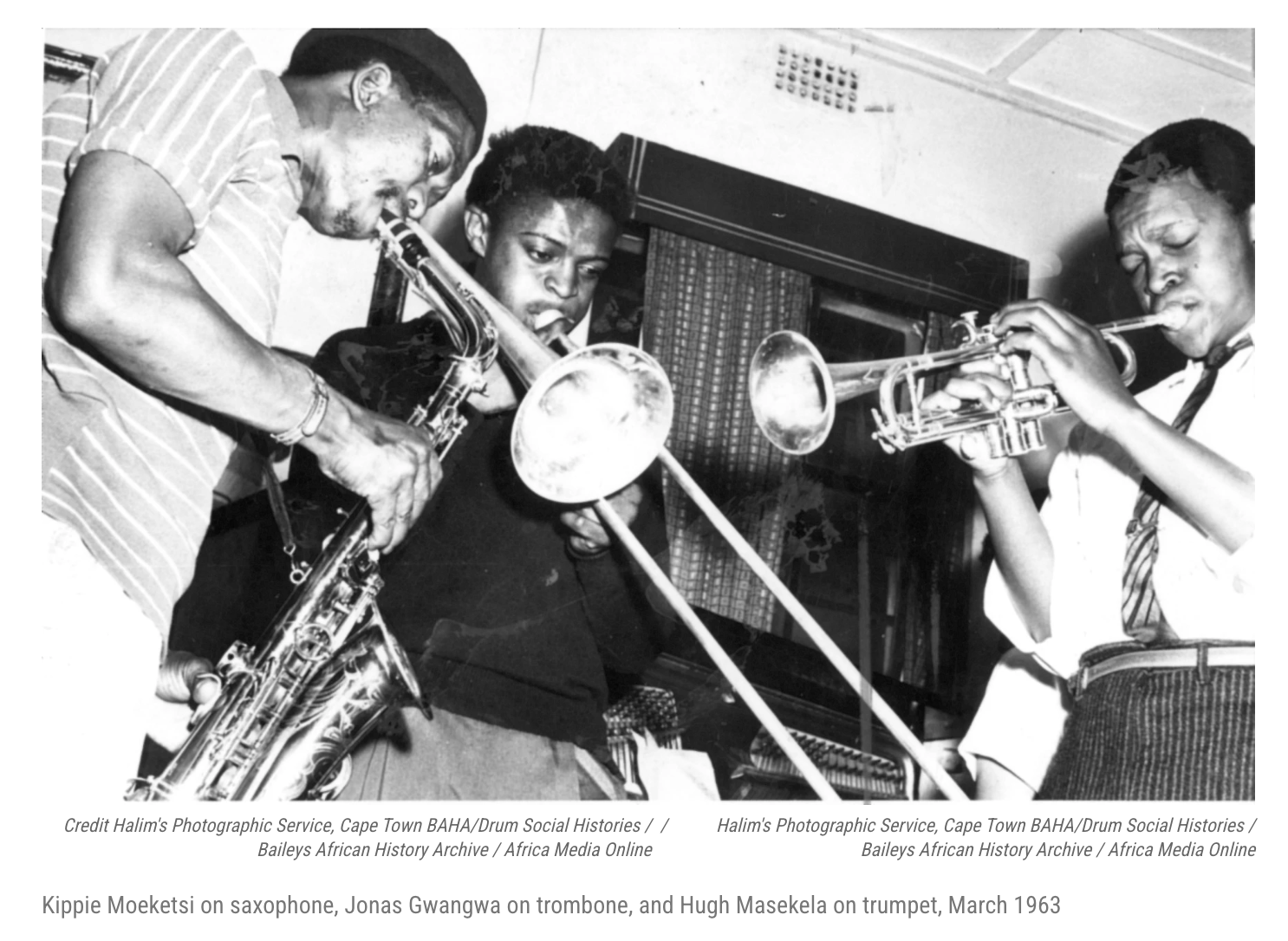
Kippie Moeketsi on saxophone, Jonas Gwangwa on trombone, and Hugh Masekela on trumpet, March 1963.
A Moment in South African Jazz History
March 1963 captures a rare and telling convergence in South African jazz history. Kippie Moeketsi on saxophone, Jonas
Gwangwa on trombone, and Hugh Masekela on trumpet appear together at a pivotal moment. The image represents not merely a
lineup of exceptional instrumentalists, but a generation of artists whose music carried cultural memory, resistance and
aspiration during one of South Africa’s most repressive political eras.
Historical Context
By 1963, apartheid had entered an intensified phase. The Sharpeville Massacre lay three years in the past, political
organizations had been banned, and artists increasingly found themselves under surveillance or forced into exile. Jazz
musicians occupied a precarious position, celebrated for their artistry yet constrained by segregation laws that
controlled movement, performance and association.
Within this environment, jazz functioned as both refuge and resistance. Performances became acts of defiance and
rehearsals acts of preservation. The gathering of Moeketsi, Gwangwa and Masekela in March 1963 reflects a final
flowering of an extraordinary local scene before the mass departure of South African jazz talent accelerated abroad.
The Musicians
Kippie Moeketsi, widely regarded as the father of South African jazz, was a central architect of the country’s modern
jazz language. His alto saxophone style fused bebop fluency with township phrasing, establishing an idiom that would
shape generations to come. By 1963, Moeketsi’s sound was fully formed, lyrical, restless and unmistakably local.
Jonas Gwangwa, then early in his international ascent, brought a bold and harmonically adventurous trombone voice. His
playing bridged big band sensibility with small ensemble exploration, while his compositional instincts already
suggested the large scale works he would later produce in exile.
Hugh Masekela, on the verge of global recognition, played trumpet with clarity and brilliance that carried deep
emotional weight. His tone was direct, singing and distinctly African, and though his international career was imminent,
in 1963 his music remained closely tied to the immediacy of the South African experience.
Musical Significance
The combination of saxophone, trombone and trumpet evokes the frontline of a horn ensemble, a format suited to dialogue,
call and response and collective improvisation. In these settings, the musicians functioned not only as soloists but as
conversationalists, shaping musical statements that reflected social realities such as tension and release, assertion
and restraint.
The importance of this moment lies not in a specific recording, but in its symbolic weight. Each musician would soon
follow a different path, some into exile, some into declining health, all into legend. March 1963 stands as a threshold
between an era rooted in South African soil and a global dispersal that carried its sound to the world.
Legacy
Today, this moment endures as archival testimony to a generation that transformed adversity into art. Moeketsi’s
foundational influence, Gwangwa’s compositional reach and Masekela’s global advocacy collectively define the DNA of
South African jazz.
March 1963 is remembered not for spectacle, but for presence. Three horns, three voices and a shared commitment to music
as cultural record and instrument of survival.
This Months Feature —
Kippie Moeketsi on saxophone, Jonas Gwangwa on trombone, and Hugh Masekela on trumpet, March 1963.
A Moment in South African Jazz History
March 1963 captures a rare and telling convergence in South African jazz history. Kippie Moeketsi on saxophone, Jonas
Gwangwa on trombone, and Hugh Masekela on trumpet appear together at a pivotal moment. The image represents not merely a
lineup of exceptional instrumentalists, but a generation of artists whose music carried cultural memory, resistance and
aspiration during one of South Africa’s most repressive political eras.
Historical Context
By 1963, apartheid had entered an intensified phase. The Sharpeville Massacre lay three years in the past, political
organizations had been banned, and artists increasingly found themselves under surveillance or forced into exile. Jazz
musicians occupied a precarious position, celebrated for their artistry yet constrained by segregation laws that
controlled movement, performance and association.
Within this environment, jazz functioned as both refuge and resistance. Performances became acts of defiance and
rehearsals acts of preservation. The gathering of Moeketsi, Gwangwa and Masekela in March 1963 reflects a final
flowering of an extraordinary local scene before the mass departure of South African jazz talent accelerated abroad.
The Musicians
Kippie Moeketsi, widely regarded as the father of South African jazz, was a central architect of the country’s modern
jazz language. His alto saxophone style fused bebop fluency with township phrasing, establishing an idiom that would
shape generations to come. By 1963, Moeketsi’s sound was fully formed, lyrical, restless and unmistakably local.
Jonas Gwangwa, then early in his international ascent, brought a bold and harmonically adventurous trombone voice. His
playing bridged big band sensibility with small ensemble exploration, while his compositional instincts already
suggested the large scale works he would later produce in exile.
Hugh Masekela, on the verge of global recognition, played trumpet with clarity and brilliance that carried deep
emotional weight. His tone was direct, singing and distinctly African, and though his international career was imminent,
in 1963 his music remained closely tied to the immediacy of the South African experience.
Musical Significance
The combination of saxophone, trombone and trumpet evokes the frontline of a horn ensemble, a format suited to dialogue,
call and response and collective improvisation. In these settings, the musicians functioned not only as soloists but as
conversationalists, shaping musical statements that reflected social realities such as tension and release, assertion
and restraint.
The importance of this moment lies not in a specific recording, but in its symbolic weight. Each musician would soon
follow a different path, some into exile, some into declining health, all into legend. March 1963 stands as a threshold
between an era rooted in South African soil and a global dispersal that carried its sound to the world.
Legacy
Today, this moment endures as archival testimony to a generation that transformed adversity into art. Moeketsi’s
foundational influence, Gwangwa’s compositional reach and Masekela’s global advocacy collectively define the DNA of
South African jazz.
March 1963 is remembered not for spectacle, but for presence. Three horns, three voices and a shared commitment to music
as cultural record and instrument of survival.